
HC10DTF, a 10 kg payload collaborative robot for food and life science applications
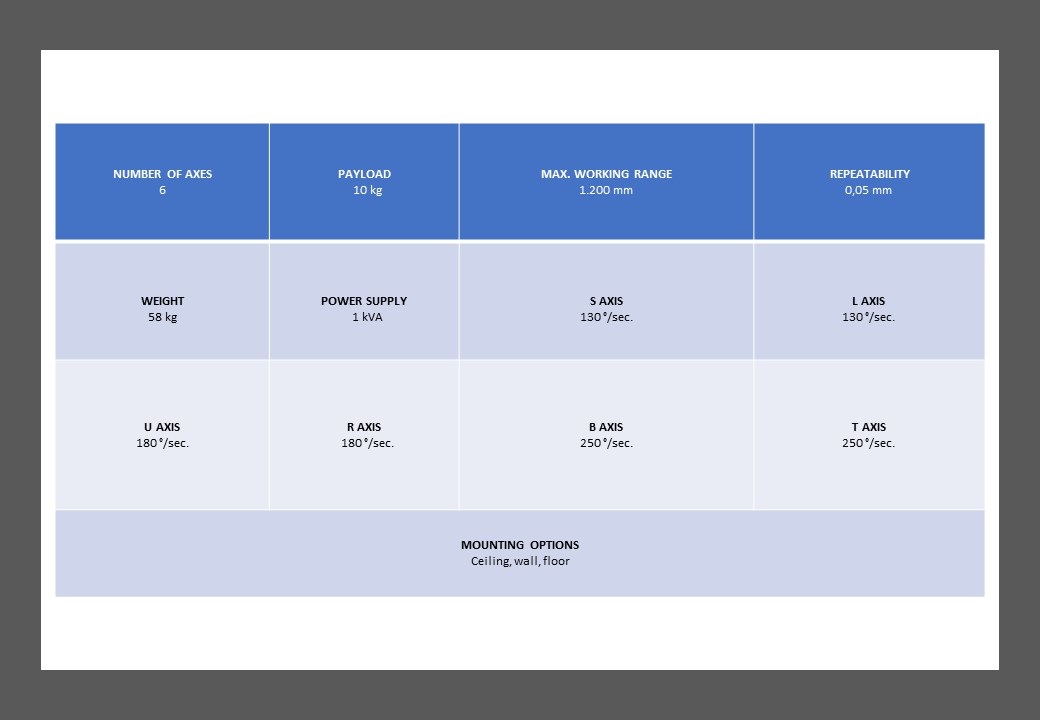
The MOTOMAN HC10DTF robots are 6 axes, human-collaborative robots with a payload of up to 10 kg. Operator’s safety is assured by a Power and Force Limit technology that stops the robot in case of contact with an operator.
Complying to EN 60529-IP67, they are dust and waterproof protected to operate in harsh environments. The chemical proof surface resists acid or alkaline cleaning fluid. Protection class IP67 for Food Grade Grease and ISO cleanroom class 5 allow these robots to be used in food related applications, as well as in Life Science Applications.
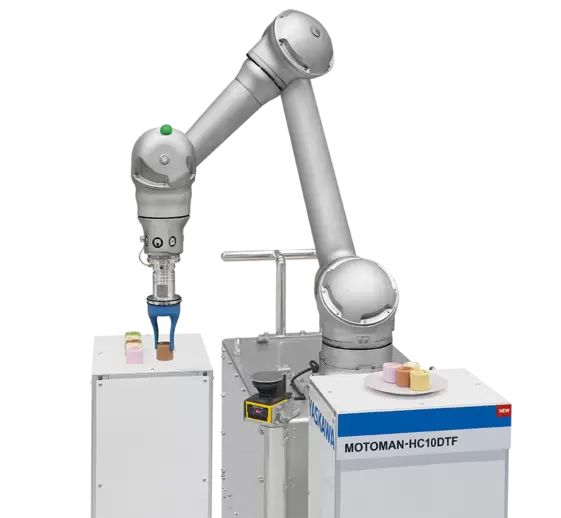
Direct Teach Buttons close to the robot flange are perfect for easy hand guiding programming, allowing to teach robot paths without involving other input devices. Installation, Setup and Programming is very easy and intuitive.
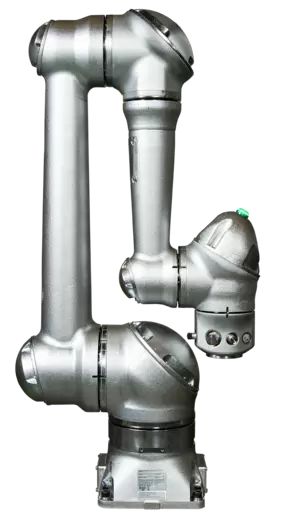
Media Cables (to supply grippers and tools) are wired inside the robot arm, two versions with Pneumatic (-B10) or Ethernet (-B12) cabling are available – in many cases, an externally mounted dress pack is not required.
Technical details
HRC-capable hybrid robot
Like all models in the MOTOMAN HC series, the new HC10DTF is also an HRC-capable hybrid robot. This means that it can be also be operated in hybrid mode by connecting external safety technology, e.g. a laser scanner. As a result, the cobot alternates between collaborating, reduced and full speed, in order to achieve a maximum cycle time depending on the distance to the operator.
Due to six integrated torque sensors that enable flexible interaction between the robot and its environment, the newly developed model ensures the required safety in direct contact with the operator. These monitor any external forces that may occur, guaranteeing the highest level of safety in direct human-robot collaboration. In industry mode, i.e. when no human being is present, the robot achieves top speeds of up to 1 m/s. Area monitoring of this type can be implemented with external safety sensors such as laser scanners.
The hybrid mode, i.e. switching between collaboration and industry mode, guarantees maximum economic efficiency with minimum space requirements. This is particularly advantageous when integrating into existing systems where space is at a premium and the use of safety guards is impractical, such as end-of-line stacking.