
Choosing between conventional and robotic palletizing
In modern times, most plants automate the palletizing process. Not only does it remove the risk of injury to workers or potential damage to the products, but it’s also more efficient and productive than any manual labour process. When the choice is made to automate, however, the decision-makers have to select between the two options available: conventional and robotic.
Conventional palletizers come in two sub-categories: low-level and high-level. The former is responsible for rotating and aligning the products along a conveyor depending on the pallet configuration. In terms of high-level palletisers, the products are still carried along the conveyor, but it’s the pallet that’s adjusted.
Robotic palletisers function using exactly what’s in the name: robots. In a robotic palletizing system, the products often enter the station from an infeed conveyor. By programming the application required, the robot then stacks products onto the pallet in a user-defined pattern.
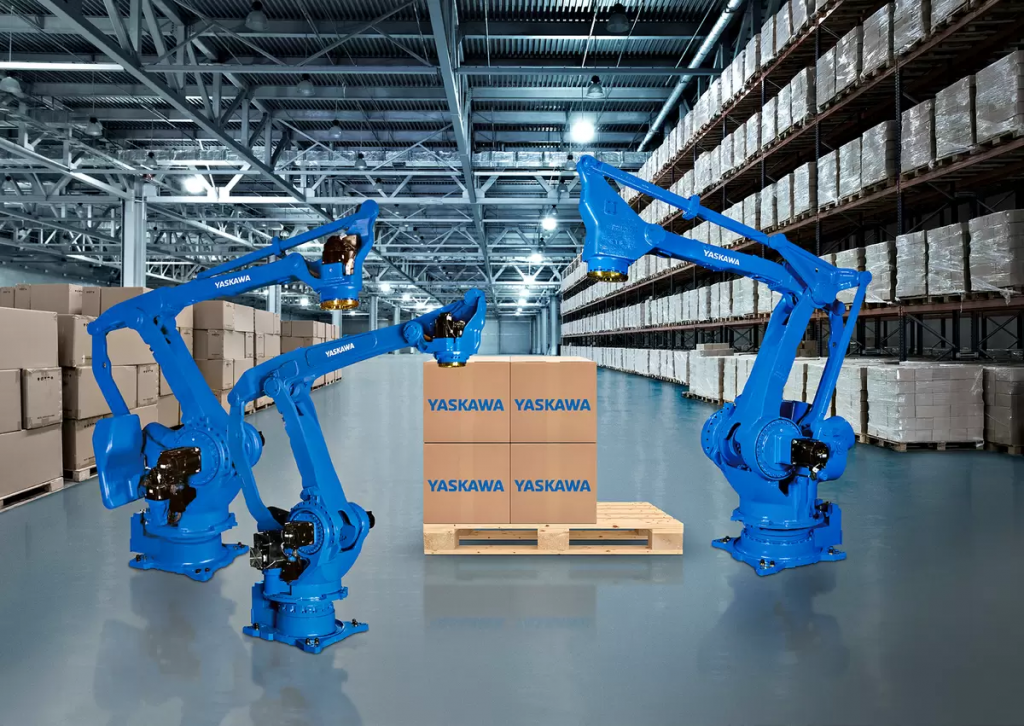
Of course, every organization wants to know which is the right choice for their respective operation. The answer depends on the following:
Speed
Every organization dreams of high-speed operations. The faster something is done, the more you can do of it, or focus on other business requirements. When it comes to palletizers, conventional is generally considered the faster option – however, this isn’t always the case.
It actually depends on the weight, size and shape of the product in the palletization process. Most robotic systems are capable of handling more than one unit at a time since the robots can collaborate and work across multiple production lines.
Versatility
As touched upon above, robotic palletizers are fully capable of executing multiple tasks – something that makes them appealing to businesses with different products in their range. The specialised end-of-arm tools are adaptable to all sorts of functions – from vacuum-suctioning to magnetic grips. This is particularly useful if you need to adapt production rates for whatever reason.
In addition, robotic palletizers are modular in design. Whether you need to add or remove units from the process, it’s entirely possible without causing any unnecessary downtime to the production line.
Precision
With the ability to program functions to user-defined standards, robotic palletizers enable an unmatched precision for applications. Imagine you have to place pails on pallets for instance. There’s a need for them to be placed in a specific way on top of each other for it to work. Robots are capable of working to sub-millimeter accuracy, which is beyond the capability of conventional palletizers. It’s this type of precision that could be the difference between success and failure.
Maintenance
Conventional palletizers feature a variety of mechanical operations. Due to wear and tear, you will need to keep a closer eye on them. Depending on the issue and how quickly it can be repaired, there’s also the possibility of significant downtime.
On the other hand, robotic palletizers consist of fewer mechanical components. As a result, they’re considered far more reliable and break down less frequently. In fact, the most common failure is the gripper. To mitigate potential downtime, larger organizations have a spare gripper that can be quickly swapped out to keep the line running. That being said, supervisors and staff handling the robots will need specialized training on how to handle the maintenance of the machines.
Space
Conventional palletisers are normally large in size and take up a lot of floor space. For organizations struggling with the available square metreage, this could prove to be a problem. While the size of robotic palletisers may vary, they’re considered far more flexible and capable of fitting into tighter spaces.
Source: Yaskawa Europe
See the Yaskawa palletizing robots range.
Normandia team has the industry expertise and technical knowledge to customize a turnkey solution that addresses your needs.
Contact us for more information.
alexandru.stanica@normandia.ro
+40-759048603